What home insurance costs on the 30A coast, and why
The question comes up on almost every 30A showing, usually in the driveway, usually half under the buyer's breath: so what is the insurance going to run me? It is the right question. It is also the one the internet answers worst, because most articles quote a statewide average that has almost nothing to do with a home sitting a few hundred feet off the Gulf.
So here is a straight read on home insurance on the 30A coast: what drives the cost, what the coverage actually is, and how to think about it as a buyer instead of getting blindsided at closing.
In this guide
- The two policies you actually need
- What flood insurance costs here, and why zone is everything
- What moves your homeowners premium
- The hurricane deductible nobody reads until it matters
- Citizens, the private market, and where 2026 is heading
- How to run the numbers before you buy
- 30A insurance FAQ
The two policies you actually need
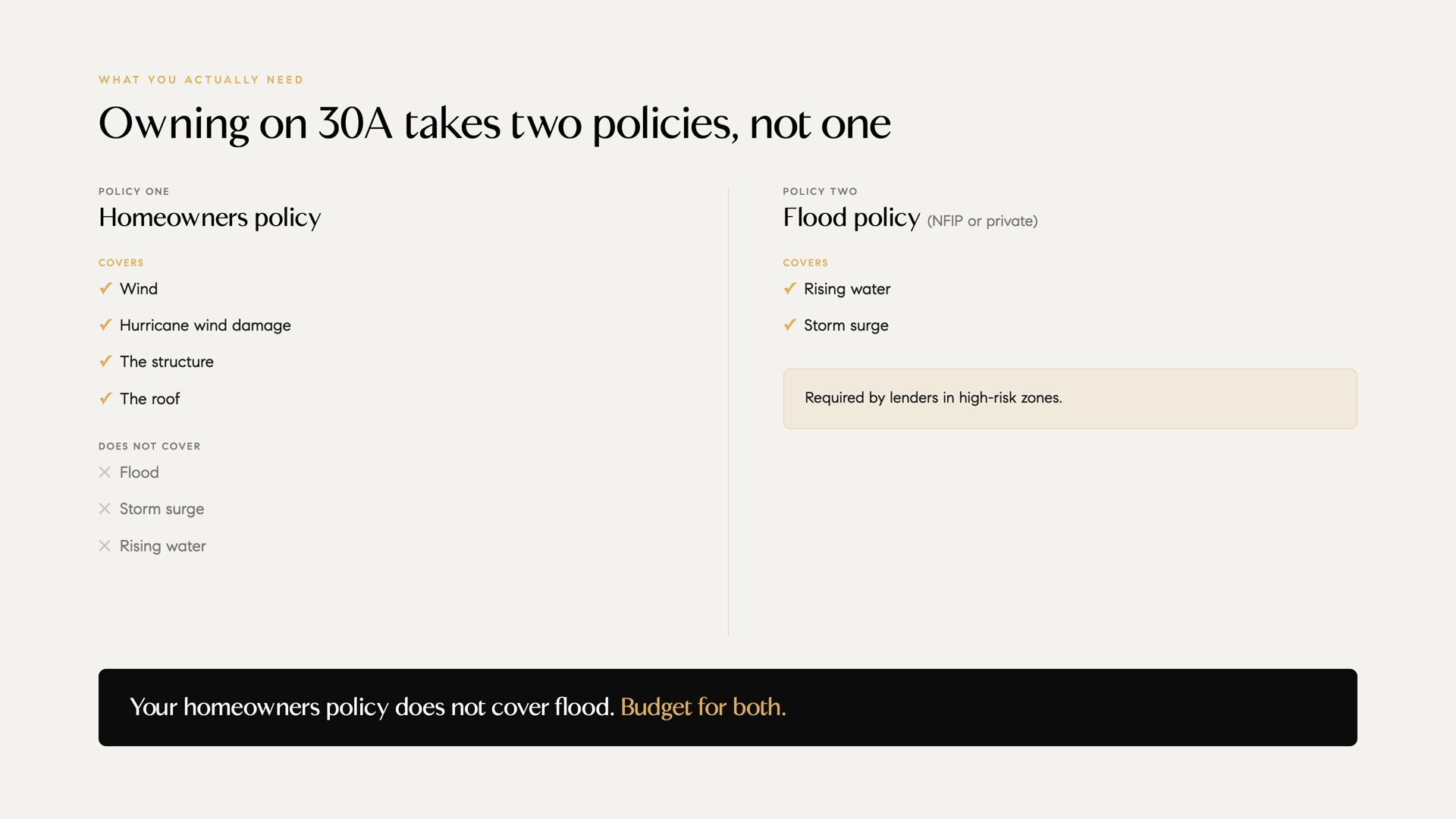
This is the single thing we most want a coastal buyer to understand, so we will say it plainly. A standard homeowners policy on 30A covers wind, hurricane damage, and the structure. It does not cover flood. Rising water and storm surge are excluded, no matter how much hurricane coverage you carry.
Flood is a separate policy, either through the federal National Flood Insurance Program (NFIP) or a private flood carrier. If your home sits in a high-risk flood zone and you have a mortgage, your lender will require it. If you are paying cash or sitting in a lower-risk zone, no one forces you to carry it, but going without it on this coast is a bet we would not make. More than 40 percent of national flood claims come from properties outside the high-risk zones.
So when you are budgeting for a 30A home, budget for two numbers, not one. The wind-and-structure policy, and the flood policy. People who only price the first one are the people who get surprised.
What flood insurance costs here, and why zone is everything
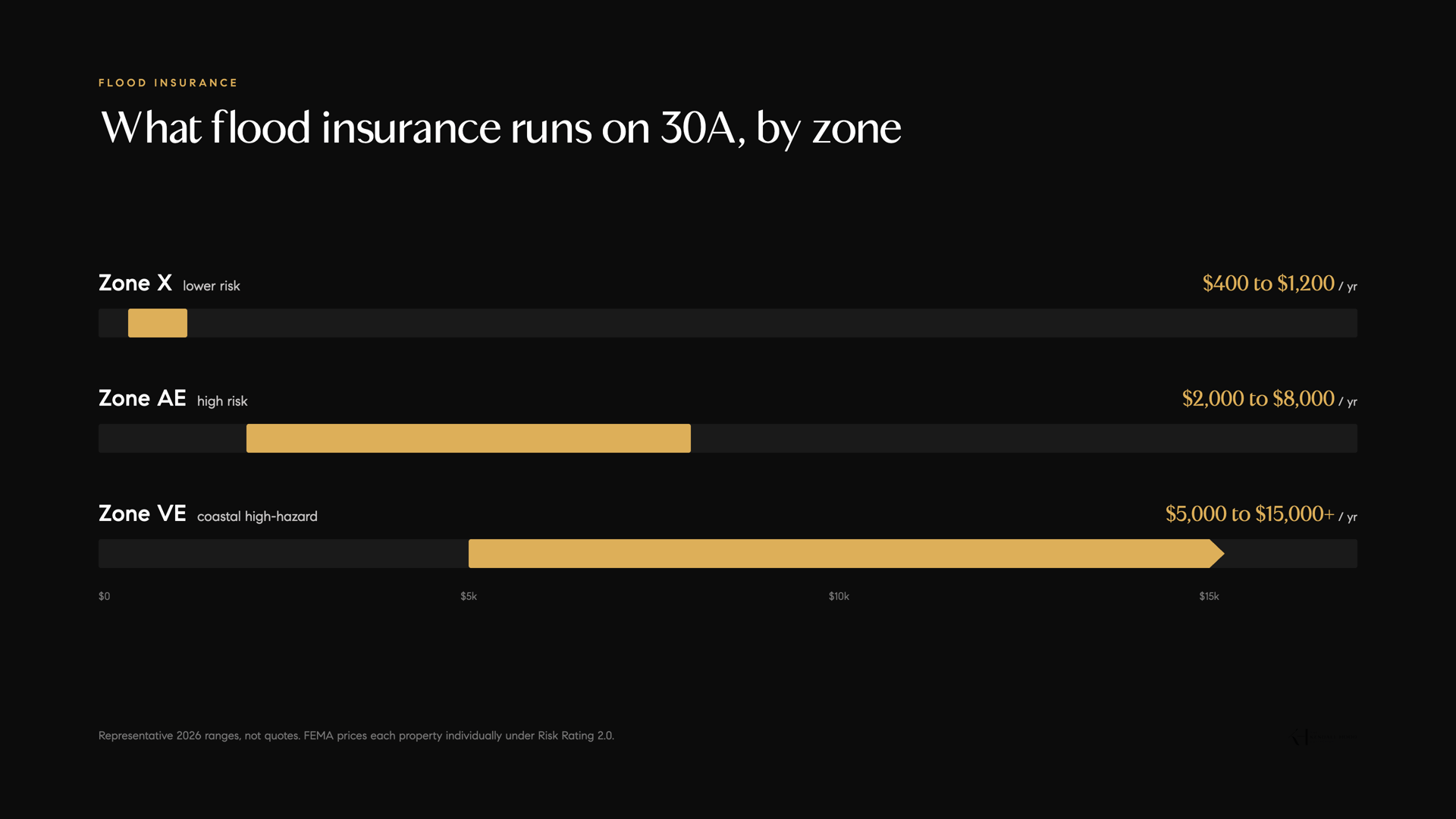
Flood pricing on 30A is driven almost entirely by your FEMA flood zone, and the spread is enormous. Here is the rough 2026 shape of it, drawn from current Florida flood-market data:
- Zone X (lower risk): roughly $400 to $1,200 a year. Common for lots set back north of 30A.
- Zone AE (high risk): roughly $2,000 to $8,000 a year. A one percent annual chance of flooding.
- Zone VE (coastal high-hazard, wave action): roughly $5,000 to $15,000+ a year, and true gulf-front homes can run higher. This is where many first-tier 30A properties sit.
Since 2023, FEMA prices flood under a system called Risk Rating 2.0, which rates each property individually by elevation, distance to water, and rebuild cost rather than by a flat zone tier. Translation: two houses on the same street can carry very different premiums. The only way to know a specific home's number is to quote the exact address.
One trap for luxury buyers: the NFIP caps building coverage at $250,000 and contents at $100,000. On a home that would cost well over a million dollars to rebuild, that federal cap leaves a large gap. That is why most higher-value 30A homes pair NFIP with a private or excess flood policy that can write much higher limits, add living-expense coverage, and replace contents at full cost. Private flood has grown fast here and is often worth quoting side by side with the federal option.
What moves your homeowners premium
On the wind-and-structure side, 30A premiums are among the highest in the country, and a handful of factors do most of the work. Here is how they push:
Factor | Which way it pushes cost | Why it matters on 30A |
|---|---|---|
Flood zone and distance to the Gulf | Closer and lower means higher | Gulf-front and first-tier lots carry the steepest exposure of any 30A property. |
Elevation | Higher elevation lowers cost | An elevation certificate can meaningfully change a flood premium on the same lot. |
Roof age and material | Newer roof lowers cost | Roof age is one of the first things a Florida carrier prices, and an old roof can block coverage entirely. |
Wind mitigation features | More features lower cost | Impact windows, roof straps, and a hip roof can earn real credits. A wind mitigation inspection commonly saves 20 to 45 percent. |
Construction type | Concrete block lowers cost vs. frame | Masonry and modern coastal construction generally price better than older frame builds. |
Dwelling replacement cost | Higher rebuild cost means higher | You insure the cost to rebuild, not the purchase price, and coastal rebuild costs keep climbing. |
The practical takeaway: two homes at the same price can carry very different insurance costs, and the cheaper house to buy is sometimes the more expensive house to own. A newer roof and impact-rated windows are not just nice features. They are a line item on your premium every single year.
The hurricane deductible nobody reads until it matters
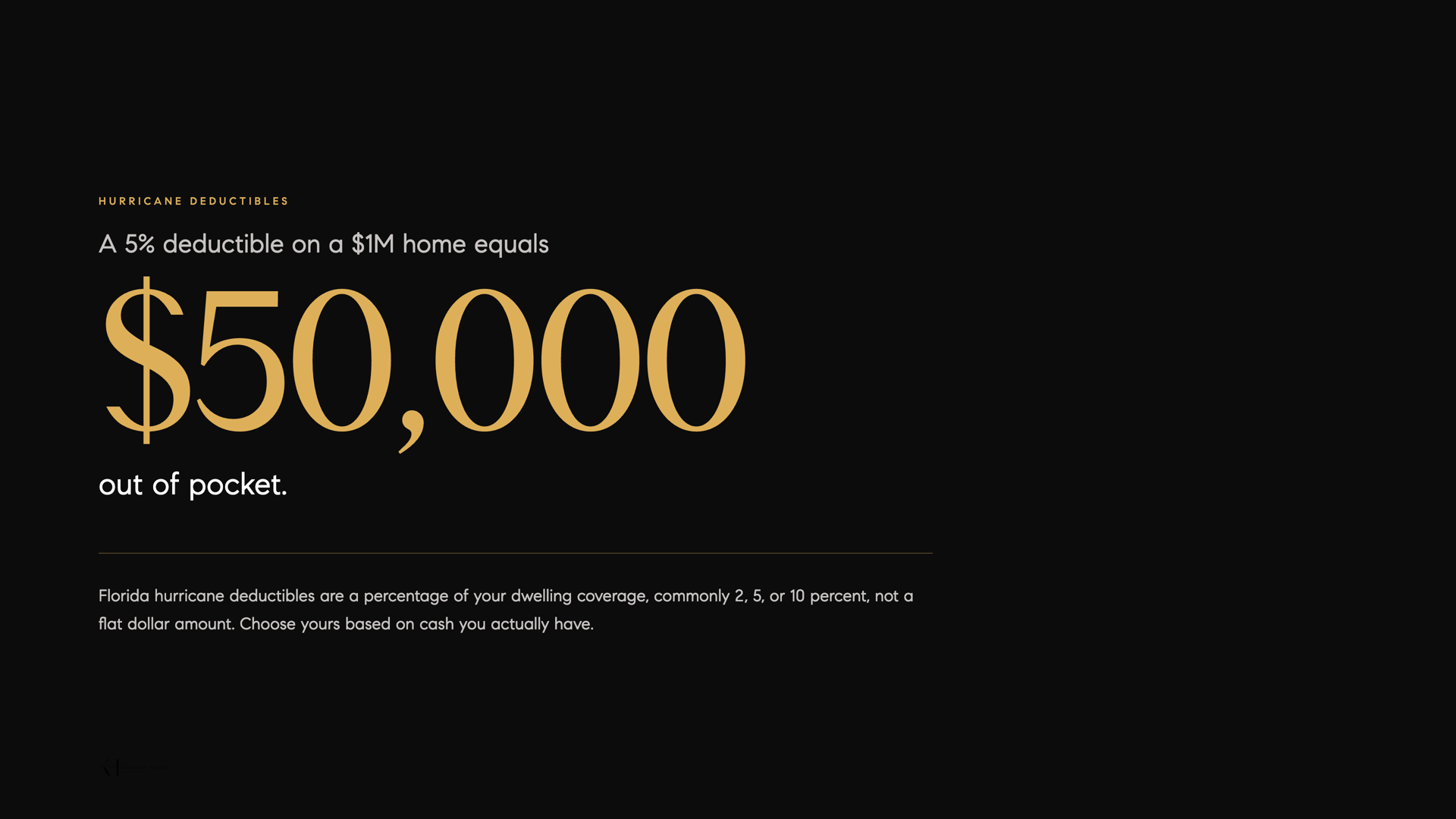
Florida coastal policies carry a separate hurricane deductible, and it works differently than people expect. Instead of a flat dollar amount, it is usually a percentage of your dwelling coverage, commonly 2, 5, or 10 percent, and it kicks in when a hurricane is officially declared.
Do the math on that before you sign. On a home insured for one million dollars, a 5 percent hurricane deductible means you are covering the first $50,000 of storm damage yourself. That is not a reason to panic, but it is a reason to keep real cash reserves and to understand exactly which deductible you are choosing. A higher deductible lowers your premium, which is fine if, and only if, you could actually absorb the hit.
Citizens, the private market, and where 2026 is heading
For a few brutal years, many Florida buyers had one option: Citizens Property Insurance, the state-backed insurer of last resort. That has changed. As private carriers returned to the market, the Citizens policy count fell from about 1.4 million to under 400,000, and for 2026 Citizens filed its first rate decrease since 2015, an average cut of roughly 8.7 percent.
One nuance worth knowing: a Citizens policy carries assessment risk, meaning policyholders can be charged extra after a severe storm season to help cover statewide losses. Private policies do not carry that risk. So the cheapest quote on paper is not always the cheapest policy over a bad year, and that tradeoff belongs in any comparison.
The bigger picture for 2026 is cautious good news. State reforms in 2022 and 2023 sharply reduced the litigation and claims abuse that drove premiums up, several carriers have filed rate reductions, and new insurers are writing in Florida again. Rebuilding costs are still climbing, so this is stabilization, not a return to cheap. But for the first time in a while, shopping your coverage on 30A can actually turn up better options than you would have found two years ago.
How to run the numbers before you buy
Here is how we coach buyers to handle insurance so it never becomes a closing-week surprise:
- Quote the exact address early. Not a neighborhood estimate, the specific home, for both wind and flood, before your inspection period runs out.
- Pull the flood zone up front. A good agent does this as part of due diligence. VE, AE, and X tell very different financial stories.
- Ask for the wind mitigation report and roof age. These two documents move the premium more than almost anything else.
- Compare NFIP against private flood. Especially on higher-value homes where the federal cap leaves a gap.
- Budget the total carry, not just the mortgage. Wind plus flood plus taxes is the real monthly number.
None of this is a reason to walk away from 30A. It is a reason to buy with clear eyes. We have watched too many buyers fall for a house, skip the insurance homework, and get a number in week three that changes the whole deal. That is avoidable, and avoiding it is part of our job.
If you want the honest carry cost on a specific home, send us the address. We will help you line up quotes from licensed insurance professionals and fold the real numbers into your decision, the same way we do it for every buyer we walk this coast with. For the storm-readiness side of ownership, see our hurricane-season guide to protecting your property .
30A insurance FAQ
Does homeowners insurance cover flooding on 30A?
No. A standard homeowners policy covers wind and hurricane damage to the structure, but it excludes flood, including storm surge and rising water. Flood is always a separate policy through the NFIP or a private flood carrier. This is the most common and most costly misunderstanding for coastal buyers.
How much is flood insurance on 30A?
It depends almost entirely on the flood zone. In 2026, lower-risk Zone X homes commonly run about $400 to $1,200 a year, high-risk Zone AE homes roughly $2,000 to $8,000, and coastal high-hazard Zone VE homes roughly $5,000 to $15,000 or more, with true gulf-front properties running higher. FEMA now prices each property individually, so the only reliable figure is a quote on the exact address.
Why is Florida home insurance so expensive?
Florida is the most expensive state in the country for home insurance, roughly two to three times the national average. The drivers are hurricane and storm-surge exposure, the high cost of reinsurance, rising rebuild costs, and years of litigation-heavy claims that recent state reforms have worked to reduce. Coastal properties like those on 30A sit at the high end of that range.
Are Florida insurance rates going down in 2026?
The market is softening for the first time in years. State-backed Citizens filed an average rate cut of about 8.7 percent for 2026, its first decrease since 2015, and several private carriers filed reductions as competition returned. That said, rising rebuild costs mean this is stabilization, not a return to cheap, and coastal homes remain the most expensive to insure.
Do I need flood insurance if my 30A home is in Zone X?
A lender will not require it in Zone X, and you are not legally forced to carry it. But over 40 percent of national flood claims come from properties outside high-risk zones, so on this coast we strongly recommend carrying it anyway. Zone X premiums are also relatively affordable, which makes the coverage easy to justify.
What is a hurricane deductible?
On Florida coastal policies, the hurricane deductible is usually a percentage of your dwelling coverage, commonly 2, 5, or 10 percent, rather than a flat dollar amount. It applies only when a hurricane is officially declared. On a home insured for one million dollars, a 5 percent deductible means you cover the first $50,000 of storm damage yourself, so choose it based on cash reserves you actually have.
How can I lower my 30A home insurance premium?
The biggest levers are a newer roof, impact-rated windows, and documented wind mitigation features, which together can cut a premium meaningfully. A wind mitigation inspection commonly saves 20 to 45 percent. Beyond the home itself, shopping the private market against Citizens and comparing NFIP with private flood are the most reliable ways to find a better number.
The bottom line on insuring a 30A home
Insurance is not the reason to skip owning on 30A. It is simply part of owning here, and the buyers who do best are the ones who price it honestly and early. Two policies, not one. Flood zone drives the flood number. Roof, elevation, and wind mitigation drive the rest. And a real quote on the real address beats any average you will read online, including ours.
If you are weighing a specific home and want the true cost to own it, send us the address and we will help you get the actual numbers, then decide with full information. That is the only way we know how to do it.
About Kendall Hood. Kendall Hood is the founder and principal of The Kendall Hood Collection at Compass and a founding agent of Compass 30A. An Alabama native who grew up vacationing on this coastline, she began her career in hospitality at the Waldorf Astoria in New York, spent six years selling new construction at Emerald Grande in Destin, and has spent more than 20 years learning every pocket of the 30A-to-Destin corridor. She lives on 30A with her husband, Jim, and their two children. Read more about Kendall .
Last updated: July 2026. The Kendall Hood Collection at Compass, 2048 W County Hwy 30A, Suite 107, Santa Rosa Beach, FL 32459. (850) 974-4556.